

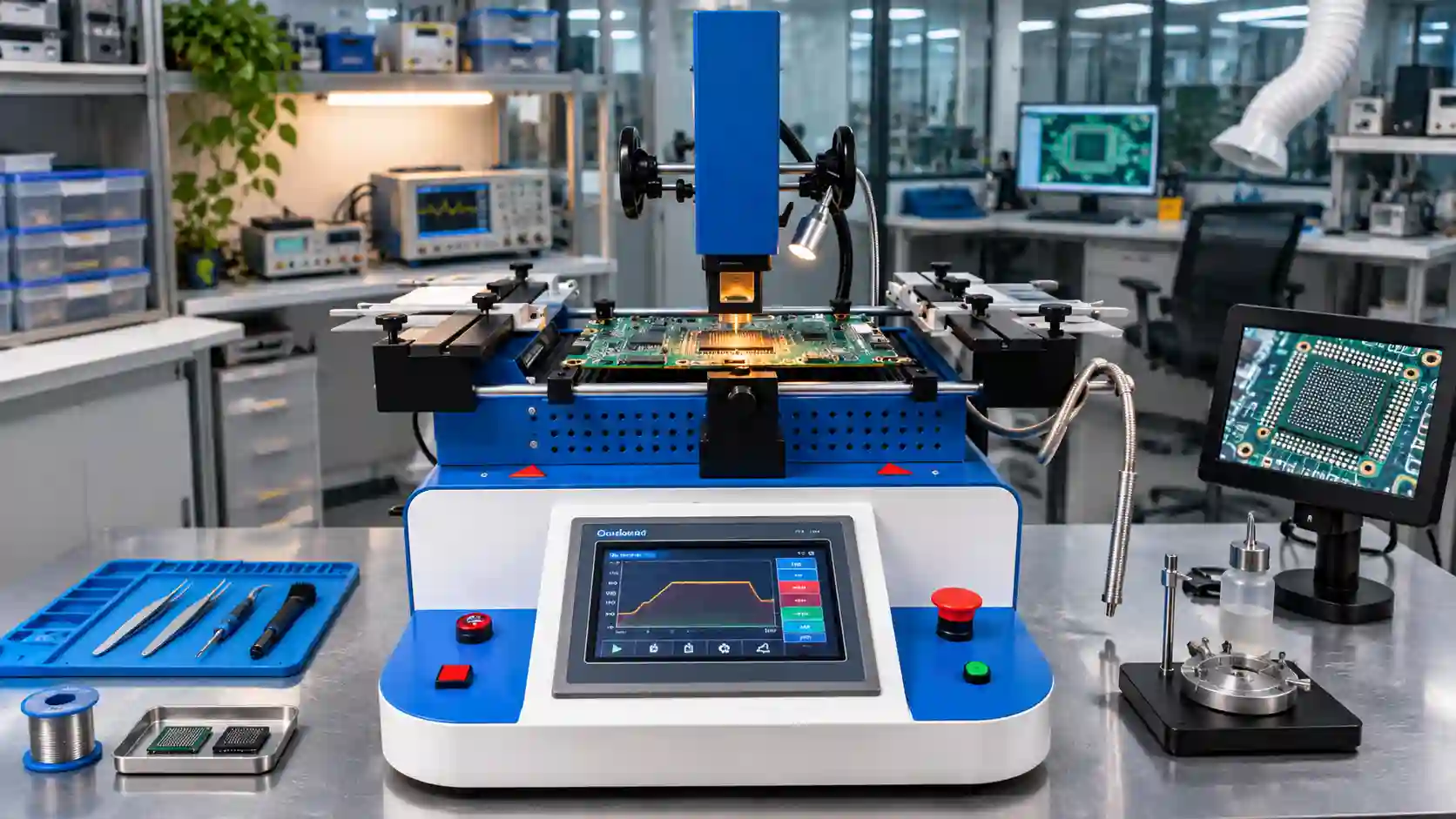
In any electronics repair, a specialty PCB repair shop should have the tools and equipment necessary to perform complex repairs. Today's circuit boards are densely populated with components in a small space, such as the Ball Grid Array (BGA) chips, which are hard to remove or replace without damaging other components on the board. With a small temperature difference or positioning of the chips, it can affect the whole process, and there is no margin for error.
Reliable Spares and Consumables is a trusted source of BGA Rework Station. It allows technologists to safely remove, replace, and reinstate BGA components while raising the component temperature in a controlled manner and locating the component for accuracy.
For repair shops often repairing motherboards, servicing PCBs, and replacing BGA chips, the R5860 BGA Rework Station is a model to consider. However, is this an appropriate investment for your lab? If you have to make a decision, you need to find out how it works, the technicalities, and its application for various repairs.
R5860 BGA Rework Station: What is it?
A BGA rework station is equipment specially designed for the removal and installation of BGA chips on printed circuit boards. The BGA chips have solder balls below the package, as opposed to the conventional chips that have visible leads. This can make it difficult to remove and replace manually.
The equipment model of R5860 is one of the options to consider when performing controlled rework operations with BGA.Will depend on whether or not it is appropriate for the heating manager, temperature checking, positioning of the components, and compatibility with your technicians' PCB assemblies. The goal of repair professionals is just one: solder reliably and without risk of damaging the PCB or adjacent components.
Key Features to Consider Before Selecting the R5860
The following are some of the main features to be taken into consideration before selecting the R5860:
Before buying this equipment, here are some factors to consider.
1. Heating Control and Accuracy of Temperature
This category is the heating control and the accuracy of the temperature.
One of the most critical factors of the BGA rework is the temperature control. Too much heat can cause damage to sensitive parts, and too little heat can make it so that the solder doesn't melt. There should be a machine available to provide controlled heating during the rework process.
The operators should be able to determine or alter settings according to the component and PCB requirement for monitoring temperature fluctuation. Before purchasing, check for the heating zones, temperature control, and compatibility with different soldering requirements.
2. Triple Zone Heating Configuration
Devices like a triple zone BGA rework station include three heating zones used for controlling the heat.
These typically include:
- Area of Top heat application for the BGA.
- Bottom Heating Zone: To heat the PCB from the bottom. This assists the melting of the solder in a more controlled fashion.
- Preheating zone: Slowly heats the board, and temperature control is in this zone.
- This configuration may also allow technicians to have a more monitored heating procedure when taking chips off and putting on chips.
But the performance will really hinge on the specification, heating capacity and temperature regulation of the equipment.
3. BGA Chip Alignment
Correctly positioning the BGA parts is crucial for replacing the BGA. As the soldering point is underneath the chip, there may be problems with soldering even if there is a little misalignment.
The BGA Repair Station should provide a suitable alignment arrangement that would allow the components to be positioned for proper alignment before they are soldered. When testing the R5860, check the camera and/or optical alignment system, positioning control, and the chip sizes it supports.
4. Temperature Profiles for Various Parts
The heating conditions are different for different BGA and PCB assemblies. The temperature profile is the profile of how heat is applied in the rework process.
Typical BGA temperature profiles have four stages in well-planned:
- Preheat stage: Raises the temperature of PCB gradually.
- Soaking stage: Equates the temperature of the board and the component.
- Reflow stage: Heats up to a high enough temperature to melt the solder.
- Cooling stage: Provides a controlled cooling down of soldered joints.
The profiles should be selected by the technicians based on the solder alloy, component specifications, PCB thickness, and manufacturer's recommendations.
Technical Specifications to Check Before You Buy
The following table talks about the technical specifications that need to be considered before placing an order.
| Technical Parameter | What to Check | Why It Matters |
|---|---|---|
| Heating configuration | The number of zones normally used for heating. | Supports controlled heating |
| Temperature control | Fidelity and range of adjustments | Helps prevent thermal damage |
| Alignment system | The setup of the camera and positioning.The positioning and camera setup. | Improves chip placement |
| PCB compatibility | Supported board dimensions | Determines repair applications |
| BGA compatibility | Supported chip sizes | Supports the management of various aspects |
| Temperature profiles | Programmable profile availability | Can accommodate various soldering needs |
| Cooling arrangement | Cooling control | Assists the solder's melting and solidification process.Solder's melting and solidifying process. |
| Software interface | Programming and operating controls | Makes operation convenient |
| Accessories | Nozzle, holder and fixture | Can be used for various types of repairs |
| Safety features | Overheating protection and alarms. | Supports safer operation |
What Sorts of Repair Work Can It Help With?
A BGA Rework machine can be beneficial in repair shops that often deal with intricate circuit boards.
1. Troubleshooting Laptop and Desktop Motherboard
Diagnosing motherboard problems on Macs and PCs.
Motherboards include multiple integrated circuits that can be damaged or have failed soldered joints and need to be replaced.
A proper rework station may alleviate the need to perform unnecessary manipulation of neighboring components while replacing faulty BGA chips.
2. Graphics Card Repair
Graphics cards have a large number of electronic components and processors packed into a small space. BGA rework equipment can be used to help with the servicing of the chip level as it relates to BGA connections, or to replace components.
3. Industrial PCB Repair
Many industrial electronic equipment requires complicated circuit boards, and they are costly to replace. If the board is serviceable, but faulty parts need to be reconstructed, that may be a viable solution for the repair.
4. Electronic Device Servicing
Different repair centers may need to use versatile PCB Rework Equipment for component repair and replacement in their work related to electronic devices. Before engaging in these jobs, compatibility with the real boards and components should always be checked with the machine.
Will the R5860 BGA Rework Station Work for Your Rework Station?
The answer will vary based on the requirements for work, technology, and investment.
The R5860 may be worth evaluating if your repair lab
- Frequently repairs motherboards and graphics cards.
- Removes and replaces BGA chips.
- Uses various PCB sizes and types of components.
- Needs more control of heating and positioning of the chip.
- The expansion to more sophisticated types of electronic repairs.
If you have to solder, replace connectors, or make basic repairs on most of the components, however, you might not need a specialized BGA machine.
It is preferable to buy equipment that matches the actual amount of repairs performed than to buy a more sophisticated machine that may not be used much.
The BGA Rework Station and Traditional Soldering Station
One frequent inquiry from the repair technicians is if they actually need a BGA machine when they already have standard soldering equipment.
This is the difference primarily based on the kind of repair work.
For common soldering and desoldering applications, where connections can be accessed using conventional soldering equipment, it is adequate. But the components of BGA have soldered connections at the bottom of the chip, and it is hard to handle with ordinary tools.
A special BGA Rework Station was created to meet these specific requirements by using controlled heat, in some cases component alignment, and programmable temperature profiles.
Traditional soldering tools may not have all the features that are available on dedicated repair equipment for repair labs that specialize in repairing motherboards and chips.
What Makes Reliable Spares & Consumables So Special?
Though selecting the right equipment is important, it's not the only component of a reliable repair lab. The reliability of the supplier, the availability of spare parts, technical information, and after-sales service are other important factors.
In the selection of BGA rework equipment and BGA repair, it is necessary to take into account the reliable spare parts and consumables.
Prior to making your purchase, discuss the following points:
- Product specifications: Ask for detailed technical specifications/operating parameters.
- Sample: get the know: How of the machine before the trial.
- Spare parts: Get to know which spare parts and other accessories you need.
- Technical assistance: Seek help on installation, troubleshooting, and getting help with operation.
- Consumables: Ensure compatibility of available nozzles and other everyday supplies.
If you are searching for R5860 BGA Rework Station Suppliers or R5860 BGA Rework Station in India, then compare such providers based on product documentation and ability.
Top Mistakes Made When Buying a BGA Rework Station
It's easy to miss crucial factors when buying new repair equipment, even for experienced technicians.
Some of the typical pitfalls:
- Price alone: A low-price ticket is not always a wise investment in the long run.
- Failure to consider PCB compatibility: Make sure that the machine is compatible with the types of boards you service on a frequent basis.
- Lacking temperature control: Sensitive parts can be damaged by inadequate heat control.
- Failure to verify alignment features: Correct alignment of the chip is a key element to the successful BGA replacement.
- Failure to consider spare parts availability- When the spare parts are not available, maintenance activities will be affected.
- Failure to train the operator- Failure to operate the machine properly can result in rework jobs that are not successful.
Doing a bit of research before you buy will prevent your repair shop from needless expenses and problems.
Conclusion
Selecting the right BGA rework machine is a crucial choice in any electronics repair company that wishes to undertake more intricate PCB servicing tasks.
An R5860 BGA Rework Station may be a good choice for your lab if you are frequently involved in motherboard repair, BGA chip replacement, and other precision electronic repairs. The final choice should be based on proven specifications, matching capabilities, heating effectiveness, alignment characteristics, and service offered by the supplier.
|
Contact Reliable Spares & Consumables for a discussion of your equipment needs and possible options for purchase. |
Frequently Asked Questions (FAQs)
1. What is the R5860 BGA Rework Station used for?
The R5860 BGA Rework Station is intended to assist repair technicians in removing, replacing, and installing BGA chips on printed circuit boards. Whether a BGA rework station is the right choice for a given repair is largely determined by the features, configuration, and technical specifications.
2. How does a Triple Zone BGA Rework Station improve the rework process?
A Triple Zone BGA Rework Station enables the best control of temperature in the top, bottom, and pre-heating zones. You can have more even temperatures on your PCB, which in turn makes the removal and installation of BGAs easier when set up correctly.
3. Why is temperature profiling important in BGA rework?
Temperature profiling enables the technician to manage a BGA's heating, as well as cooling, cycles. A correct temperature profile will aid in creating good soldering, provide consistent and predictable results, and help to prevent those tiny but critical parts on the PCB from being "cooked" with too much heat.
4. Can you BGA Rework a motherboard?
Yes. BGA rework equipment is used for motherboard-level rework, BGA chip removal, replacement, and solder joint rework if they are suitable for the board and the component.
5. What is the thing I have to keep in mind before buying the R5860 BGA Rework Station online in India?
Decomposing of the heating zones, accuracy, Supported PCBs, chip matching, alignment, programmable profiles, spare parts, after-sales, etc.
6. How to select trusted R5860 BGA Rework Station Suppliers?
Find vendors that can supply confirmed product specifications, information, parts availability, operational support, warranty, and after-sales information.