

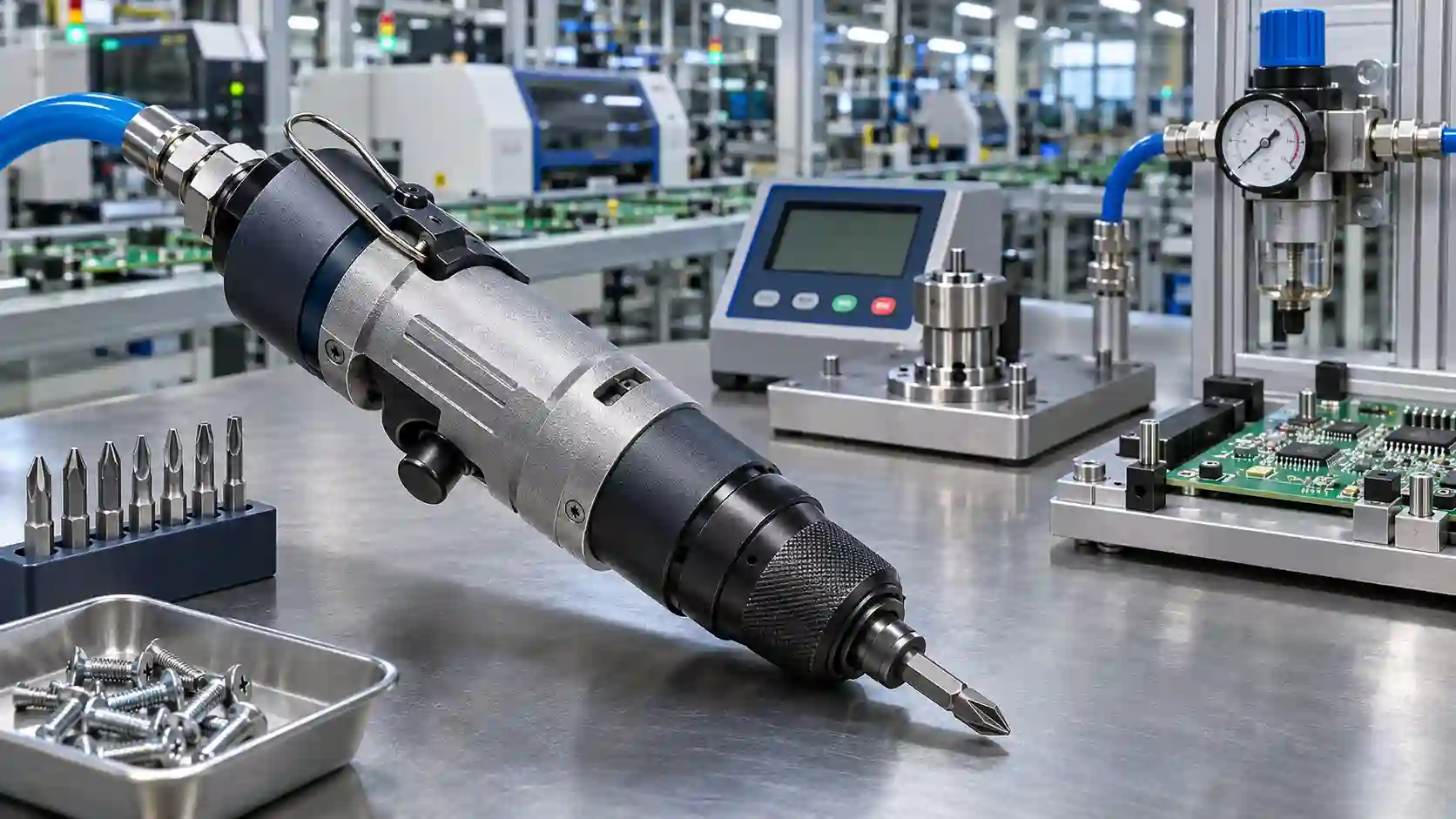
An air tool can appear to be ready to go, the moment it hits the air line. It almost never is. On a busy assembly line, a minor setup mistake doesn't fire off a warning. It emerges much later as a loose screw, a stripped head or a handful of parts returned for rework.
With the most basic of elements, and if you're not getting consistent performance from your screwdriving operation, your outcome can vary. Air supply, torque values and bit choice have an effect, and a shortfall in any of these areas will impact on quality. That's why you should give the Pneumatic screwdriver setup a serious consideration.
The checklist is to be used by engineers prior to approving a new Drebon screwdriver for production so the tool will operate the same across every shift and every operator.
Why Does Proper DrebonScrewdriver Setup Matter?
Proper setup is what makes for repeatable fastening. A good Drebon pneumatic screwdriver ensures the same job quality from the first screw to the thousandth, not to mention repeatable auto shut off and smooth assembly between operators and shifts.
One difference is relevant here. While installing the tool is not the same as checking the torque between joints.
- Setup readies the device and air supply.
- Verification confirms what the joint actually receives.
You need both. The first without the second is a guess.
Drebon Pneumatic Screwdriver Specifications
Before going through the checks, keep the key specifications of the tool in front of you. Every check below refers back to these values.
| Specification | Details |
|---|---|
| Model | DB-SD-Q35PB |
| Type | 1/4" Push To Start Auto Shut Off Air Screwdriver |
| Drive Size | 1/4" Hex |
| Torque Range | 3-20 Kgf.cm / 0.3-2.0 Nm |
| Free Speed | Approx. 2200 RPM |
| Air Pressure | 50 psi |
| Air Inlet | 1/4" PT / NPT |
| Weight | Approx. 0.6 kg |
| Length | Approx. 15.5 cm |
7 Essential Checks Before Setting Up a DrebonScrewdriver
Complete all seven of these checks before putting the tool into production. These checks provide a useful Drebon screwdriver setup checklist for any Pneumatic screwdriver on your production line.
Verify Torque Range and Fastening Requirements
This model has a torque range of 0.3-2.0 Nm. Begin by comparing that range to your assembly specification.
- Make sure the specified torque fits within the screwdriver torque range.
- Choose the appropriate tool for the screw type and the joint needs.
- Don't view the maximum variety being a promise.
The rated range only indicates the torque that can be expected at the joint. The Drebon screwdriver torque setting should always be checked on actual parts.
Check Air Pressure, Air Quality and Supply Stability
This model indicates 50 PSI. Check it on the tool, not on the compressor.
- Measure pneumatic screwdriver air pressure with the tool in operation.
- Observe drops when you have multiple instruments on a single line.
- Employ filtering and conditioning as directed in the tool manual.
Fresh, constant compressed air supply ensures protection of the tool and the quality of the fastenings. Pressure indicated on the gauge at the regulator may conceal problems further down the hose.
Confirm Air Hose, Inlet and Connection Compatibility
The listed inlet designation is 1/4-inch PT/NPT. Check this value against the fitting on your tool, because fittings with similar thread appearance may not be compatible.
- Check hose size and connector specifications.
- Inspect for leaks at every joint.
- Observe any kinks or restrictions starving the tool.
A secure pneumatic screwdriver air inlet connection and the same hose help maintain pressure. Having suitable air hose compatibility will also save you from hours of chasing performance mysteries down the line.
Select the Correct Screwdriver Bit
Yes, it is using a ¼ inch hex interface, so first determine that the size of the shank of the bit is right. Then the profile must also be exactly the same with the head of the screw.
- Choose the appropriate profile and size of the fastener.
- Replace worn bits promptly.
- Watch for slipping and cam-out.
Screwdriver bit compatibility helps protect the fastener head. As industrial screwdriver bits wear out, they alter the seating position, which impacts each screw thereafter.
Check Screw Size, Joint Material and Assembly Conditions
The same application of the same tool can be radically different on different joints. And not just because of the position of the fastener. Fastener dimensions, thread engagement, joint hardness and seating surfaces all contribute. Friction does too.
- Review screw length, diameter and thread condition.
- Account for coatings, lubricants and hardness.
- Test on representative production components.
These factors directly affect screw fastening accuracy. A setup proven on a sample plate may not hold on the real assembly, so test with real parts.
Test Push-to-Start and Auto Shut-Off Operation
This is the check that completes the circle. Select an appropriate method of torque measurement and test joint connections.
- Fasten sample joints under real conditions.
- Record the readings.
- Document results for traceability.
A push to start a pneumatic screwdriver that behaves well is a good sign. But an auto shut off screwdriver stopping on cue does not prove the joint meets its torque specification. That needs measurement.
Verify Fastening Torque Before Starting Production
This is the check that closes the loop. Use a suitable torque measurement method and test sample joints.
- Fasten sample joints under real conditions.
- Record the readings.
- Document results for traceability.
Screwdriver torque verification is different from periodic tool calibration or validation. One checks the joint now. The other checks the tool over time. Good torque quality control uses both.
Pre-Production Dragon Screwdriver Setup Checklist
Re-runs this list before every single batch of the new release. Store a signed copy with your files.
- The tool model matches the job specification.
- Torque setting suits the assembly requirement.
- Regulated air supply registers at the tool.
- Hose and inlet tightly sealed, no leaks.
- Bit type and condition are correct.
- Sample fastening completed on production parts.
- Operator instructions are clear and always on the station.
- Verification records are filled in and stored.
A Drebon screwdriver checklist can be completed in just a few minutes, but could save hours of sorting out and rework.
Common Setup Mistakes Engineers Should Avoid
Even a skilled team will also trip up on a few of the more obvious points. Such pneumatic screwdriver setup errors can cause inconsistent fastening quality.
- Using free-speed RPM as an indication of performance.
- Overlooking pressure drops during a load application.
- Using worn or unsuitable bits.
- Assuming auto shut-off guarantees torque.
All three of them seem to be pretty small. Between them they justify a lot of the mismatched fastening.
Why Choose Reliable Spares & Consumables for DrebonScrewdrivers?
Buyers get a clear spec and reliable availability. Reliable Spares & Consumables shows the Drebon screwdriver and its key specifications, so engineers can check if they can match it to their needs before placing an order. Torque range, pressure and inlet details are easily compared to your own line.
If you are looking for Drebon screwdriver suppliers or a Drebon pneumatic screwdriver in India, share your fastening requirements with Reliable Spares & Consumables and request model information. The team can help you confirm fit before you buy.
FAQs
1. What air pressure does it need?
The manual for this model states that the requirement is 50PSI. The manual should be checked before starting work. Take the pressure reading at the tool when running; don't just look at the regulator.
2. How do engineers verify fastening torque?
Take measurement with appropriate equipment and process. Sample representatives fastened joints in normal service conditions. Document the measurements so you can monitor variation between shifts and between batch lots.
3. Does auto shut-off guarantee consistent tightening?
No, it doesn't. Its results are adjusted by the torque, the joint and the tool state. Its real-time consistency is confirmed through periodic verification of sample joints
4. Which bit fits this screwdriver?
The tool accepts a 1/4-inch hex shank. And you need to make sure it has a compatible profile and diameter with the head of the screw. Change bits that are no longer sharp to prevent it from slipping.
5. Can any air hose be used?
Not necessarily. Verify the 1/4-inch PT/NPT inlet marking on your fitting. Confirm that the hose size and fitting match the tool and check for leaks.
6. How often should the setup be rechecked?
Observe instructions and own quality procedure. Re-iterate after re-fixing screws, joint material, and pressure supply. Testing a quick sample before each batch is still good practice.
Conclusion
You can’t assemble a Drebon screwdriver any more than you can screw in a screw without a drill. But it does require discipline. Seven checks and you’ll have the essentials covered: torque range; air pressure; match hose and inlet; bit selection; condition of joint; push to start / off; and torque validation. Appropriate air supply, logical torque settings and documented validation keep assembly uniform between shifts and operators. Leave out one of these steps and you will have rework.
| Need a budget Drebon screwdriver for your assembly line? Tell Reliable Spares & Consumables your torque and air supply needs and we will supply you with model information. |