

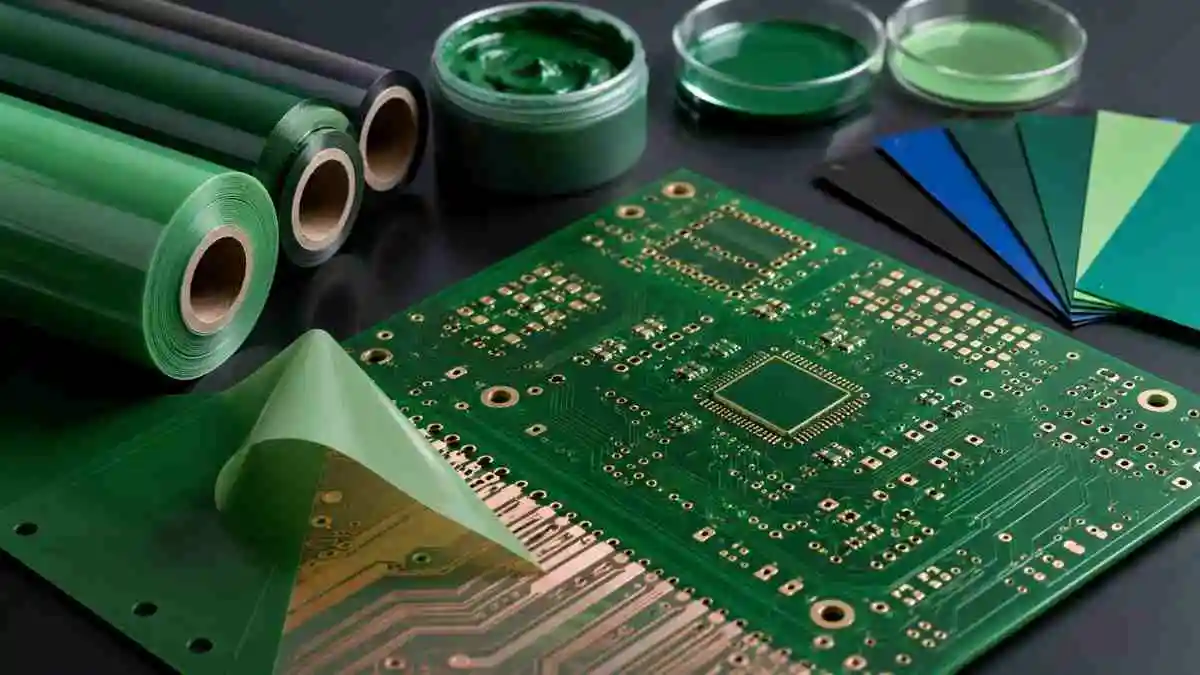
A practical, plain-language guide to choosing the right protective coating for reliable, defect-free circuit boards.
Anyone who has spent real time on a PCB assembly line probably stopped noticing the coating years ago. It's just there, usually green, easy to walk past a hundred times a shift. But that layer is doing more than most people realize. It's called Solder Mask, and getting it wrong, wrong material, uneven application, whatever the cause, means chasing solder bridges and corrosion problems that eat up far more diagnostic time than they should. Ask a procurement person and two questions usually come up unprompted: how PCB Solder Mask varies between vendors, and why Solder Mask Price jumps around so much for what looks like the same product. Turns out both trace back to formulation and resolution. That's the ground this guide covers: what the coating actually does, which Solder Mask Types are worth knowing, and a handful of things worth checking before committing to a bulk order.
What is a Solder Mask?
Solder Mask is a thin polymer layer applied over the copper on a board, leaving only the pads and through-holes exposed for soldering. Call it PCB Masking if you want to be literal, since that's basically what it does. Molten solder tends to wander onto areas it shouldn't touch. Without the coating, or with an uneven application, two pads that were never meant to connect end up bridged, and tracing that fault once the board is fully populated is no fun. Most Solder Mask Material is resin based, usually epoxy, acrylic, or polyimide mixed with pigment, which explains the green, black, or blue finish on almost every board. The resin choice isn't only about looks. It also decides how the coating handles repeated heating and cooling over the board's life.
Why is it Important?
Here's the odd thing about a good PCB Protective Coating: you barely notice it. It only gets attention when something goes wrong. A coating that's doing its job stays invisible, which is sort of the point. When it's selected properly, it tends to:
- Keep solder from bridging pads that sit close together
- Add a layer of PCB Protection against humidity, dust, and chemical exposure
- Improve dielectric strength, lowering short-circuit risk
- Add years onto a board's working life
- Make defects easier to spot during visual inspection
Solder Mask Types and Variants
Not every board calls for the same treatment. The Solder Mask Types on the market differ in resolution, curing method, and cost, and the right pick depends on what's actually being built.
- Epoxy Solder Mask is the budget option, a liquid coating for simpler designs with wider pad spacing.
- Liquid Photoimageable Solder Mask goes on wet and cures under UV light through a photo-tool. Dense, fine-pitch boards tend to need this one.
- Dry Film Solder Mask is a laminated film pressed on with heat, chosen mostly for even thickness.
- UV Solder Mask cures under ultraviolet light, speeding processing with sharper edges than some alternatives.
- Liquid Solder Mask is really the broader category of wet-applied coatings, with some room to adjust thickness.
- The Peelable Solder Mask is temporary by design. Once wave soldering, conformal coating, or selective plating is done, it peels off and the job's finished.
Features to Look For
Two coatings can look basically identical on paper, same specs, same claims, and still behave completely differently once they're actually on a board. A few things worth checking before locking in a supplier:
- How well it grips copper and laminate
- Thermal resistance during reflow and wave soldering
- Curing method, whether UV, thermal, or both
- Whether it holds up on fine-pitch, high-density layouts
- Consistency from one batch to the next
Product Overview
Reliable Spares & Consumables keeps a fairly tight range of masking and protection materials aimed at PCB assembly lines. Its peelable coating, sold under the name Chemask, covers wave soldering, conformal coating, and chemical processing jobs where only part of a board needs shielding. Anyone hunting for a Peelable Solder Mask will probably want this line first, since it reduces rework and tightens process control without leaving residue behind, useful for protecting gold fingers or test points during a run. Buyers sourcing Solder Mask Material in bulk, or for OEM supply, the formulations are batch tracked and quality tested before they leave the factory.
Benefits of Using Solder Mask
Some of the benefits are the following:
- Fewer first pass defects, less rework later
- Stronger pad adhesion through thermal cycling
- More stable electrical performance over time
- More predictable output across runs
- Cleaner visuals for automated inspection tools
| TRIVIA: Ask why a solder mask is almost always green and most people will say it's a habit. The real reason is contrast. It's simply the easiest colour to inspect under ordinary shop lighting. |
Applications and Use Cases
Solder Mask turns up at almost every stage of electronics manufacturing. A few common examples:
- Wave soldering and selective soldering runs
- Masking sensitive components before conformal coating
- BGA work and fine-pitch assembly
- Rework and repair benches needing temporary cover
- High-volume SMT lines
Each situation pulls the coating in a slightly different direction. Matching the method to the process usually matters more than chasing whatever's cheapest on paper.
Comparison Table: Solder Mask Types at a Glance
Understand the types of solder mask with the following comparison table:
| Type | Application Method | Best Suited For |
|---|---|---|
| Epoxy Solder Mask | Liquid, screen printed | Basic, low-density board designs |
| Liquid Photoimageable Solder Mask | Liquid, UV imaged | High-precision, dense layouts |
| Dry Film Solder Mask | Laminated under heat and pressure | Uniform thickness requirements |
| UV Solder Mask | UV-cured liquid or film | Fast processing, sharp definition |
| Peelable Solder Mask | Temporary applied coating | Selective, removable protection |
Expert Tips and Buying Guide
Here are some of the expert tips and buying guide:
- Match the Solder Mask Types you're weighing against real pad density before placing a bulk order
- Ask what curing method a supplier actually uses, and whether it suits your setup
- Weigh Solder Mask Price against what rework would cost, since the cheaper quote isn't always the cheaper outcome
- Get batch documentation so repeat orders don't drift in quality
- Test a small sample before switching suppliers, so any curing issue shows up early
- If only part of the board needs temporary cover, a Peelable Solder Mask usually beats a permanent coating
About Reliable Spares and Consumables
Reliable Spares & Consumables, led by Mr.JK Khowal, possesses 19 years of experience in the industry, including manufacturing and supplying ESD products and industrial electronics tools in India. With their own manufacturing facility and expertise, they are one of the leading providers of customized ESD solutions, soldering stations, BGA rework stations,ESD chairs, testers and ESD static control consumables that meet customer needs in the electronics manufacturing sector.
Reliable Spares & Consumables manufactures the products using tested components and guarantees the best performance and lifespan with stringent in-house testing facilities and conformity to industry standards. With comprehensive OEM and bulk supplying options available, as well as a well established and efficient distribution channel nationwide. They are able to supply their goods promptly across India and improve workplace safety and productivity in offices.
FAQs
1. What is a solder mask used for?
Ans: Simple answer: it's the thin polymer layer coating a board's copper, pads and holes left bare for soldering. Why bother? Solder wanders — uncoated, it bridges pads never meant to touch. There's more too: moisture, dust, chemical exposure, the coating pushes back on it, and defects get easier to spot.
2. How many solder mask types exist?
Ans: Six, if you're counting: Epoxy, Liquid Photoimageable (LPI), Dry Film, UV-cured, Liquid, and Peelable. Epoxy suits basic, low-density boards. LPI handles dense, fine-pitch layouts. Dry film keeps thickness even across the board. Peelable's temporary by nature, made to come off once the job wraps, nothing permanent about it.
3. Why is the solder mask usually green?
Ans: Not tradition, contrast. Green's just the easiest colour to inspect under ordinary shop lighting, so defects jump out fast during visual checks. Black and blue versions exist too, nothing stopping a manufacturer from choosing them. Most shops just keep using whatever's already worked for years, why mess with it?
4. When should a peelable solder mask be used, and what is it?
Ans: Exactly what it sounds like, temporary. It goes on, does its job during wave soldering, conformal coating, or selective plating, then peels off clean once processing wraps up. No residue left behind on gold fingers or test points either. Good fit whenever only part of a board needs shielding, not the whole thing.
5. What should I check before choosing a solder mask?
Ans: Start with pad density, that decides most of it honestly. Basic, low-density boards? Epoxy handles it fine. Dense, fine-pitch designs need liquid photoimageable masks to hold tolerances properly. After that, check the curing method, ask for batch documentation, and run a small sample test before committing to anything bulk.
6. Why does solder mask price swing so much between suppliers?
Ans: Mostly formulation and resolution, not marketing spin. Fine-pitch, high-resolution coatings cost more to produce and test properly. Batch consistency plays into it too, tighter quality control isn't free. Here's the thing though, cheaper isn't always cheaper. Rework from a poor coating often costs way more than the price gap ever saved.
Conclusion
Getting Solder Mask right isn't paperwork, it's yield, reliability, and how long a board survives in the field. Simple designs do fine with Epoxy Solder Mask. Dense layouts generally need Liquid Photoimageable Solder Mask to hold tolerances. Either way, the decision rests on complexity, environment, and volume. Work with a supplier who treats Solder Mask Material as seriously as anything else on the bill of materials, and boards leaving the factory will cause fewer headaches later.
Explore Reliable Spares & Consumables' Solder Mask and Peelable Solder Mask range to find the right fit for your next production run.