

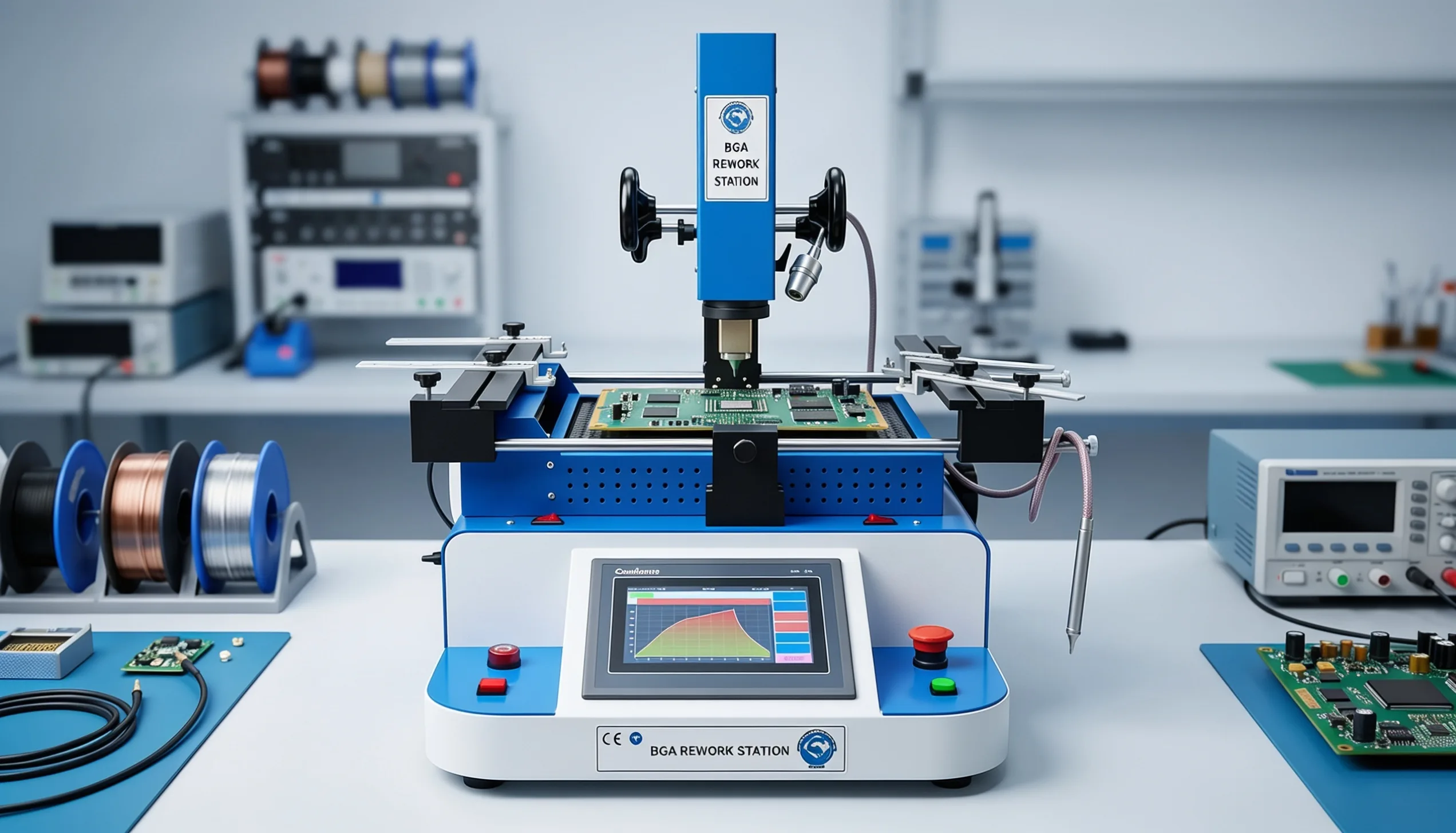
Spend any real time on a PCB assembly line and you'll notice how small these parts have gotten. Ball Grid Array chips sit flat against the board. No legs sticking out, nothing to grab with a regular iron if a joint goes bad. So when one of these chips fails, a standard soldering setup won't cut it - you need equipment built for exactly this job. That's a BGA Rework Station. It heats the board under control, lines the new chip up precisely, then lets you lift off or reinstall a component without touching anything around it. Run a repair bench, or manage one? This is the machine worth understanding.
So here's what we'll cover in this guide: what this equipment does, why it earns its keep, the types you'll run into, and what's worth checking before you spend the money.
What Is a BGA Rework Station?
In plain terms, a BGA Rework Station desolders, aligns, and resolders Ball Grid Array packages on a circuit board, something a regular iron can't manage. It heats through multiple zones instead: top, bottom, and on some models the sides too. That way the solder balls melt slowly and evenly rather than all at once. This slow rise keeps thermal shock at bay, which is why boards don't warp or crack mid-repair, particularly on dense, multilayer designs.
A typical station usually has:
- a hot air or infrared heater for the chip itself
- a bottom heater that preheats the whole PCB
- some kind of optical or laser alignment setup
- a digital controller where you save your temperature profiles
- and a cooling stage, so the board doesn't shock back down too fast
Why Does This Machine Actually Matter?
Here's the thing - a single BGA chip can carry hundreds of tiny connection points underneath it, and you can't see one without an x-ray machine. Not with a magnifier, not with the naked eye. So if even one ball fails, the entire board goes down. A good BGA Rework Station gives technicians the ability to pull a bad chip cleanly, reflow the solder evenly across the whole footprint, and drop the replacement back in with proper alignment. It cuts scrap, saves repair costs over time, and makes the high-mix, low-volume repair work that EMS and OEM shops deal with daily, actually manageable.
Try skipping all this with a handheld hot air gun and you might get lucky the first couple of times. Eventually something goes wrong: a warped board, a component fried right next to the one you were working on, or a joint that looks fine today and fails three weeks from now. These aren't small mistakes. Wasted material, blown deadlines, and clients asking uncomfortable questions.
|
TRIVIA: BGA stands for Ball Grid Array - the packaging style took off because it crammed more connections into a smaller footprint. |
Types and Variants Worth Knowing
Not every workshop needs the same machine. Broadly speaking:
- Manual Stations handle basic heating and manual alignment - fine if your volume is low
- Semi-Automatic Stations bring motorized alignment and programmable profiles, which most repair shops end up preferring
- Fully Automatic Stations use vision-guided placement, mostly seen on large EMS floors
- BGA Reflow Rework Station variants lean on multi-zone reflow profiles, built for boards with tricky layouts
Which one you pick comes down to daily rework volume, board complexity, budget, and how experienced your technician already is.
Features Worth Comparing
Before shortlisting anyone, look closely at:
- how many independent heating zones the unit has
- the maximum PCB size it can realistically take on
- whether alignment is manual, semi-automatic, or fully vision-based
- how accurate the temperature control actually is, and whether profiles save properly
- nitrogen support, which cuts oxidation during reflow
- build quality, panel usability, and what happens after you've already paid
None of this is fluff. These details decide whether your rework stays consistent months from now, or whether you're troubleshooting the machine as much as the boards.
|
DID YOU KNOW: On some multi-zone stations, the bottom heater climbs almost to reflow temperature while the top plate never even touches the board. |
Product Overview
A properly built BGA Rework Station has a solid frame, multi-zone heaters, a precise alignment stage, and a control panel that doesn't need a manual just to turn on. Quite a few buyers check BGA Rework Station Price in India before locking in a supplier, since pricing swings between manual and semi-automatic setups. Units built with proper in-house engineering, tested under real production conditions, generally hold up longer than cheaper imports - and getting spares or calibration help later tends to be less painful too.
What You Actually Gain From Using One
- better first-pass success, even on crowded, dense boards
- less thermal stress hitting the PCB and whatever's sitting near it
- less wasted material from botched rework attempts
- faster turnaround, especially on repair-heavy lines
- works fine for both prototyping and full-scale assembly
- profiles that repeat reliably instead of guesswork every time
Where You'll Actually See These Used
- PCB assembly and repair shops fixing failed solder joints day in, day out
- EMS and OEM units reworking boards right before shipment
- R&D and prototyping labs testing new component placements
- repair centers handling phones, laptops, and everyday consumer electronics
- automotive electronics manufacturers dealing with BGA-based control modules
Comparison Table: Technical Specifications
|
Parameter |
Specification |
|
Product Name |
BGA Rework Station |
|
Maximum PCB Size |
400 x 400 mm |
|
Heating Zones |
3 Zones |
|
Alignment Type |
Semi-Automatic |
|
Automation Grade |
Semi-Automatic |
|
Model Name / Number |
As Available |
|
Brand |
OAKY |
|
Power Consumption |
240 V |
|
Input Voltage |
230 V |
|
Country of Origin |
Made in India |
A Quick Buying Guide
- Match your heating zones to how complex your boards usually get - three zones covers most standard jobs
- Check the maximum PCB size against your biggest board, not the average-sized one
- Ask upfront about calibration support, operator training, and how fast spares arrive
- Look at a handful of established BGA Rework Station Manufacturers in India before trusting an import nobody can vouch for
- If money's tight, get a proper written quote instead of going off a listed BGA Rework Station Price alone, since the final number shifts with configuration
- Anyone comparing BGA Rework Station Price in Delhi or elsewhere should also weigh warranty terms and how much hands-on training comes with the machine
|
FACT: Bad rework technique is still one of the biggest reasons boards develop hidden solder joint failures later on. |
Reliable Spares and Consumables
Reliable Spares & Consumables, lead by Mr.JK Khowal, possesses 19 years of experience in the industry, including manufacturing and supplying ESD products and industrial electronics tools in India. With their own manufacturing facility and expertise, they are one of the leading providers of customized ESD solutions, soldering stations, BGA rework stations,ESD chairs, testers and ESD static control consumables that meet customer needs in the electronics manufacturing sector.Reliable Spares & Consumables manufactures the products using tested components and guarantees the best performance and lifespan with stringent in-house testing facilities and conformity to industry standards. With comprehensive OEM and bulk supplying options available, as well as a well established and efficient distribution channel nationwide. They are able to supply their goods promptly across India and improve workplace safety and productivity in offices.
FAQs
1. What exactly does a BGA Rework Station do?
It desolders, aligns, and resolders Ball Grid Array chips on a circuit board without damaging nearby components. Using multi-zone heating (top, bottom, sometimes sides), it warms the board gradually so solder melts evenly. This controlled approach prevents warping or cracking, which is especially important on dense, multilayer PCBs where precision really matters.
2. Why can't I just use a regular soldering iron or hot air gun instead?
BGA chips have hundreds of connection points hidden underneath, invisible to the naked eye. A handheld gun heats unevenly and blindly. You might get away with it once or twice, but eventually you'll warp a board, fry a neighboring component, or create a joint that fails weeks later.
3. What's the difference between manual, semi-automatic, and fully automatic stations?
Manual stations handle basic heating with manual alignment, suited to low-volume work. Semi-automatic stations add motorized alignment and programmable profiles, which is what most repair shops prefer. Fully automatic stations use vision-guided placement and are mostly found on large EMS production floors handling higher volumes.
4. What should I actually check before buying one?
Look at how many independent heating zones it has, the maximum PCB size it can handle, and whether alignment is manual or vision-based. Also check temperature accuracy, profile-saving reliability, and nitrogen support to reduce oxidation. Build quality and after-sale support matter just as much as the spec sheet.
5. Does BGA Rework Station price vary a lot between suppliers?
Yes, quite a bit. Pricing shifts depending on whether you're looking at manual or semi-automatic setups, heating zones, and PCB size capacity. It's worth getting a proper written quote rather than relying on a listed price alone, since the final number changes based on configuration and features included.
6. Who typically uses these machines?
PCB assembly and repair shops fixing failed solder joints regularly, EMS and OEM units reworking boards before shipment, and R&D labs testing new placements all rely on them. Repair centers handling phones and laptops, plus automotive electronics manufacturers dealing with BGA-based control modules, also depend on this equipment daily.
Conclusion
The Best BGA Rework Station isn't whichever one has the lowest number on the quote sheet. It comes down to build quality, how precise the heating is, alignment accuracy, and whether the supplier still picks up the phone once the sale's done. Doesn't matter if it's a small repair bench or a full EMS line, good equipment protects your boards, your components, and honestly, your patience on a tight deadline. A dependable BGA Reflow Rework Station pays for itself over time: less scrap, fewer repeat jobs, faster turnaround on every batch. Take a proper look at heating zones, alignment systems, and after-sale support before you sign anything.
Need reliable rework equipment? Contact to our team for technical guidance and product details today.