

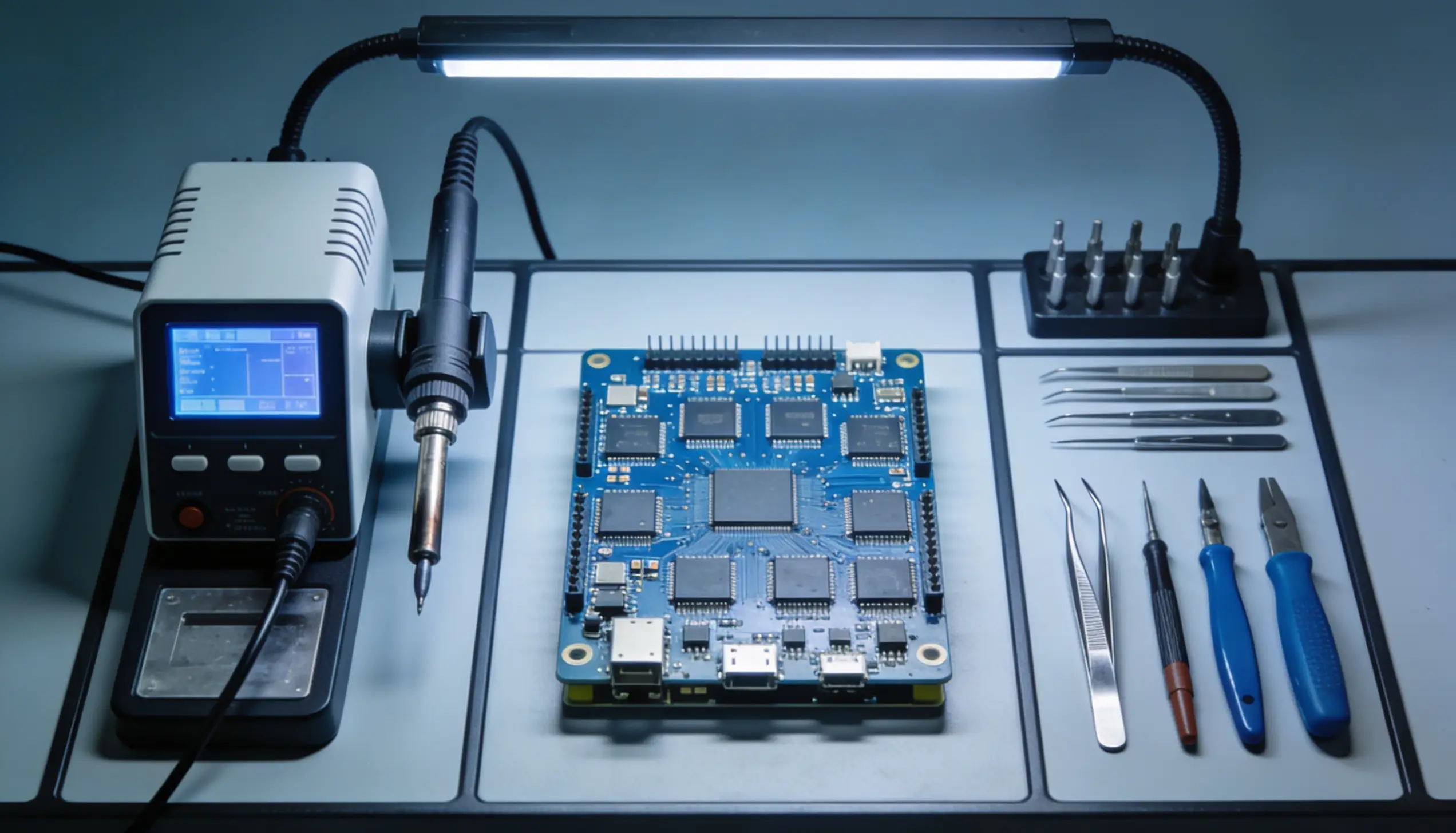
The ultimate buyer's guide to the differences, uses and buying options of your next soldering station.
The selection of an appropriate soldering station can be considered the most important choice of electronics manufacturers, assembly lines, and even maintenance workshops. Be it a precision PCB plant or a large-volume manufacturing floor, the kind of station you pick will directly influence the quality of joints, the rate of rework, and cost of operation.
Digital vs Analog Soldering Stations debate has raised a notch higher with increasing complexities in electronics. Knowing what technology fits your production space, makes sure you spend well and save time and money due to unnecessary downtime or damaged components.
What Is a Digital Soldering Station?
A Digital Soldering Station has a microprocessor-based control system that allows the tip temperature to be set, displayed and maintained at high accuracy. A closed loop sensor compares the actual temperature of the tip to the setpoint and varies the power supply on-the-fly.
Basic Technical Requirements to Consider.
- Temperature range: typically 150°C – 480°C with ±1°C–2°C accuracy
- Digital LCD/LED display to display real-time temperature.
- Programmable presets (as many as 9-12 memory slots on higher-end models)
- Power saving and auto-sleep features to save energy and increase the life of the tip.
- Design that is ESD-safe, with ground potential less than 2 mV.
- Wattage: 40 W – 80 W depending on application
What Is an Analog Soldering Station?
A single dial or rotary knob analog soldering station has no digital display, controlled by temperature by a simple dial or rotary knob. These open-loop systems are based on the experience of the user to set a reasonable amount of heat. They are durable, low-maintenance and cost efficient when used in general soldering work.
Digital vs Analog: Head-To-Head Comparison
| Feature | Digital Soldering Station | Analog Soldering Station |
|---|---|---|
| Accuracy | High | Moderate |
| Display | Digital screen | Rotary knob |
| Best For | SMD/BGA work | Basic soldering |
| Temperature Control | Precise | Manual |
| Cost | Higher | Lower |
| ESD Safety | Better | Basic |
| Ease of Use | Easy | Experience-based |
Industrial Applications
There are different functions of both types of stations in various manufacturing industries. The Best Soldering Station for your facility will vary based on the volume and complexity of soldering tasks.
- Electronics Manufacturing: SMD rework, BGA reballing and fine-pitch IC soldering requires digital precision.
- Automotive wiring harness termination (heavy gauge) requires analog for robustness.
- Aerospace & Defence: Digital stations with complete traceability logs are compliant with quality regulations.
- Telecom & Networking Equipment: Digital control reduces thermal damage on high density PCBs
- Electrical Panel Assembly: Analog stations are still the preferred choice for power connections using bus bar and terminal blocks.
- Prototype & R&D Labs: Digital stations with fast change tips speed up the design cycle
The Key Features & Benefits Are Listed Below:
To Specify Features When Sourcing
- Open Circuit PID temperature control for uniform heat recovery
- Heats quickly, (recovery time less than 5 seconds)
- Processing capacity up to 200 kW/h (700 lph) for water, up to 450 kW/h (2000 lph) for aerosol
- Operator safe password protected temperature lockout.
- If the solder fume extractor is compatible with use or includes a built-in filter.
- Environmental qualifications: CE, RoHS, IEC 60335
Benefits for Procurement Managers and Buyers
- Precise thermal management results in lower rework costs
- Lower power consumption for the component
- Reduce total cost of ownership with extended tip life and energy savings
- The standardisation of the calibration makes the quality audit and ISO compliance simpler
- Offers multi-operator programmable presets for faster training time on production lines.
Guide to Selecting Your Next Soldering Station
The following pointers will help you choose the best soldering station.
- Work requirement (SMD/BGA requires digital; through hole assembly is ok with analog)
- Required accuracy and is 1C a requirement to prevent burning your components?
- How can digital soldering station prices justify annual costs incurred to rework or replace components?
- Availability of tip replacement from manufacturer and their costs.
- ESD compliance if working on CMOS or RF devices
- After-sales support availability, warranty duration and calibration services offered.
- Ask for lead time commitment, particularly when buying in volume.
- Customizable options such as voltage requirements, branded units, OEM options
Reason to Source Soldering Station Manufacturers From India
India now ranks amongst the strong players in precision soldering equipment. Soldering Station Manufacturers in India provide all required aspects – expertise, economy and the supply chain to produce such fine equipment, at a much reduced unit cost.
- 20-35% reduced price than comparable European/Japanese brands.
- All the leading manufacturers have acquired BIS, CE, RoHS certificates.
- Custom voltage configuration is readily available for the export markets. (110 V/220 V/240 V)
- For the domestic customer delivery is comparatively quicker – in India a period of 5-10 working days.
- Efficient after-sales support network present in tier I and tier II industrial towns in India.
- Benefits under 'Make in India' and 'PLI'scheme for electronics manufacturing.
Functions of a Soldering Station Supplier.
A dependable Soldering Station Supplier or a Soldering station dealers will provide pre-sales consultation, help in selection of stations that meet production needs and will ensure timely availability of the OEM spares for replacement and calibration. They will thus, act as important sourcing partners for a company in charge of multi-plant electronics assembly in India.
About Reliable Spares & Consumables
Reliable Spares & Consumables is a reliable pioneer in electronics production, which offers high-performance ESD solutions and industrial tools. Under the leadership of CEO Mr. JK Khowal, who brings 19 years of expertise in industrial trading and supply support of the operations professionals go through on a daily basis. With long experience in manufacturing units and repair centres, Mr Khowal will guarantee that we know how the downtime and delays of equipment directly jeopardise your productivity.
Our high-quality products are supported by skilled technical services and prompt service to ensure your business runs smoothly. We have professional soldering stations and magnifying lamps, fume extractors and ESD-safe equipment such as trolleys and testers, to name just a few. Our idea is to enable electronics professionals to realise high assembly standards in a safe, efficient and downtime-free environment.
FAQs
1. What is the main difference between digital and analog soldering stations?
Ans: Digital soldering stations provide precise temperature control with a digital display, while analog stations use a manual dial for temperature adjustment.
2. Which soldering station is better for SMD and PCB work?
Ans: Digital soldering stations are better for SMD, BGA, and precision PCB applications because of their accurate temperature control.
3. Are analog soldering stations still used in industries?
Ans: Yes, analog soldering stations are widely used for general electrical repairs, through-hole soldering, and heavy-duty industrial applications.
4. Why is temperature accuracy important in soldering?
Ans: Accurate temperature control helps prevent component damage, improves solder joint quality, and reduces rework.
5. Do digital soldering stations consume less power?
Ans: Many digital stations include power-saving and auto-sleep features that help reduce energy consumption.
6. Which soldering station is more cost-effective?
Ans: Analog soldering stations are cheaper initially, while digital stations offer better long-term value through reduced rework and improved efficiency.
Conclusion
The decision of digital or Analog Soldering Station depends on the needs of the job for precision, the quantity of parts being produced and the overall cost implications. A best digital soldering station provides the accuracy and traceability of today's manufacturing demands in high density PCB assembly, SMD (surfboard mounted devices) and quality-driven situations.
As a bulk buyer, procurement manager, or Soldering station dealers, you can rest assured that the respective chains you are working with are certified Indian manufacturers, providing you with quality supplies, competitive pricing, and quality products. Carefully assess technical characteristics, choose a reliable supplier, and choose the appropriate supplier that will help meet production goals and long-term cost goals.
For a personalized quotation and product catalogue from India's top soldering station manufacturers. Buy from us, and get bulk discounts, short lead time and complete after sales support!