

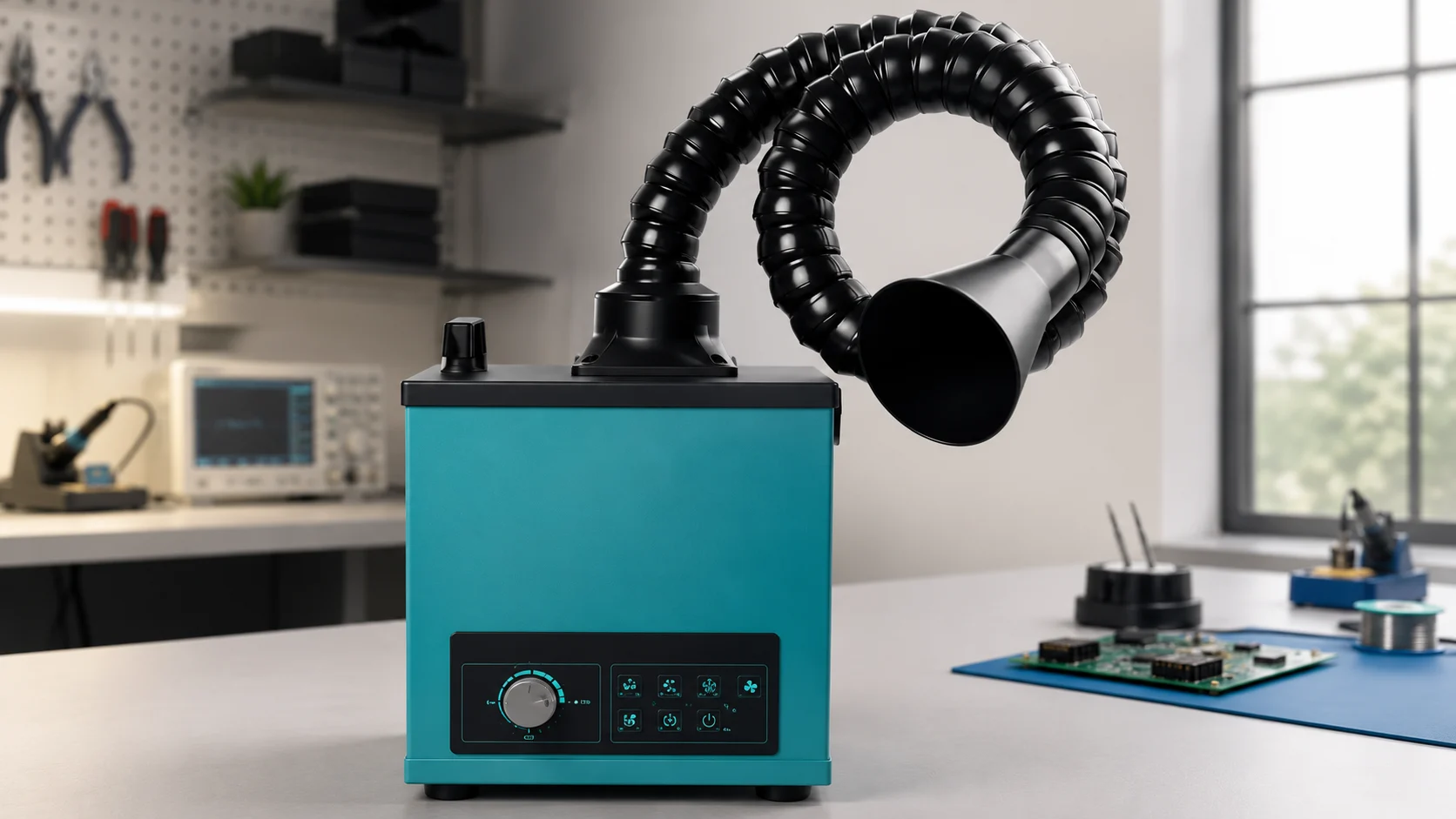
Anyone who has soldered for more than a few minutes knows the smell. That thin grey wisp rising off the joint doesn't look dangerous, but it's carrying flux particles and chemical residue straight toward your face, and over a full shift that adds up. This is the problem a Soldering Fume Extractor is built to solve. It's why the device is often grouped under Fume Extractor for Soldering setups, right alongside other Soldering Station Accessories on a technician's bench. Instead of letting smoke drift wherever it wants, the unit pulls it in right at the tip, before it ever reaches your nose. Not complicated equipment, just a small change that matters by the end of a shift.
What Is a Soldering Fume Extractor?
Strip away the branding and a Soldering Fume Extractor is basically three parts doing one job. A fan, a nozzle, filters. That's it. The fan pulls air in near the tip, the nozzle points that pull where it's actually needed, and the filters catch whatever comes through before the clean air gets pushed back out. Call it a Solder Fume Extractor, call it a Solder Smoke Extractor — people use both, and honestly it doesn't matter which one you say. Same box, same job: dealing with the fumes flux kicks out during PCB work.
Why Is It Important?
Flux isn't harmless once heat hits it. It gives off rosin-based compounds that irritate eyes and airways, and if a workshop's got several irons running for hours straight, that irritation stops being a once-in-a-while thing pretty fast. A Soldering Fume Extraction System keeps exposure low enough that nobody's quietly dreading the smell by mid-shift, and it keeps a facility on the right side of basic safety expectations too.
Then there's the equipment side, which people forget about. Flux residue is sticky stuff, it doesn't stay on skin, it ends up on lenses, connectors, whatever's sitting closest. A room with bad airflow just makes that worse. An open window helps a little. A dedicated extraction unit actually solves it.
Types and Variants
Not every workspace needs the same setup, so fume extractors come in a handful of common forms.
- Benchtop units are the smallest, placed right beside the iron and meant for one person working alone.
- Step up and you get Multi-Port Fume Extraction Systems, built to serve two or more stations at once, or portable and handheld units for repair work that moves from bench to bench.
- Bigger floors run fixed, ducted installations instead. Soldering isn't the only place these turn up, either.
- Fume extraction systems get used in welding bays, laser cutting rooms, and labs too, though the filters inside are tuned differently depending on what's being captured.
- A one-person repair bench and a twelve-station line don't need the same machine, and buying for the wrong scale usually ends in wasted money or frustration.
Features to Look For
Buying more capacity than needed wastes money, buying less means it can't keep up. What actually matters is multi-stage filtration, a pre-filter plus HEPA-grade media plus activated carbon for smell, paired with airflow rated for however many soldering points sit nearby. Noise is easy to overlook until you're a few hours into a shift and it's wearing you down, so that's worth checking too, along with clear indicators for when a filter needs swapping. A footprint that doesn't eat up half the bench alongside other Soldering Station Accessories helps as well. Get these right and you're usually looking at something people call a Best Soldering Fume Extractor pick. Not because it's flashy, but because it works, shift after shift. An adjustable arm helps too, keeping the nozzle close without getting in the way of your hands.
Product Overview
Skip the model comparisons for a second — here's just the general shape most soldering-focused units take. No size, no price tag attached, just what a typical Soldering Fume Extraction System usually looks like on paper.
|
Aspect |
What It Typically Includes |
|
Core Function |
Captures and filters soldering smoke close to the source |
|
Filtration Stages |
Pre-filter, HEPA-grade filter, activated carbon layer |
|
Operation Mode |
Continuous or on-demand suction during soldering |
|
Common Users |
Electronics assembly units, repair centres, training labs |
|
Maintenance Need |
Periodic filter inspection and replacement |
|
Typical Placement |
Near the soldering iron tip or built into the workstation |
Benefits of Soldering Fume Extractor
The payoff isn't just cleaner-smelling air, though that's usually the first thing people notice.
- Less exposure to flux fumes for whoever's holding the iron matters most, obviously.
- Beyond that, nearby components stay cleaner since residue has less chance to settle, and the air quality across the whole room tends to improve rather than staying good at just one bench.
- It also gets easier to stay aligned with basic safety expectations, and by the time a shift ends there's usually less lingering smell and less grime building up on everything sitting nearby.
Applications and Use Cases
Wherever an iron runs for more than a few minutes at a stretch, this kind of extraction shows up sooner or later. Assembly lines running boards one after another need it most, and so do rework benches handling delicate components. Small repair shops leaning on everyday Electronics Repair Tools use it too, along with training rooms where students are still learning technique. Even prototyping desks, where soldering happens in short bursts, tend to end up with one nearby.
Expert Tips and Buying Guide
A little planning saves regret later.
- Size the airflow to how many soldering points are actually active, not just how big the bench looks, and lean toward multi-stage filtration since it tends to outlast single-filter setups.
- Worth asking, too, how filters get swapped and whether that means shutting the line down.
- If soldering intensity changes through the day, adjustable suction is worth having, and if the unit runs long shifts, check the noise output before buying.
- And if you're ordering in bulk, sticking with an established Fume Extractor Manufacturers in India name usually pays off, steadier quality across units, and easier access to spare filters later.
About Reliable Spares and Consumables
Reliable Spares & Consumables, lead by Mr.JK Khowal, possesses 19 years of experience in the industry, including manufacturing and supplying ESD products and industrial electronics tools in India. With their own manufacturing facility and expertise, they are one of the leading providers of customized ESD solutions, soldering stations, BGA rework stations,ESD chairs, testers and ESD static control consumables that meet customer needs in the electronics manufacturing sector.Reliable Spares & Consumables manufactures the products using tested components and guarantees the best performance and lifespan with stringent in-house testing facilities and conformity to industry standards. With comprehensive OEM and bulk supplying options available, as well as a well established and efficient distribution channel nationwide. They are able to supply their goods promptly across India and improve workplace safety and productivity in offices.
FAQs
1. I already work near an open window. Do I still need a fume extractor?
Ans: An open window helps a little, but it doesn't control airflow the way an extractor does. Smoke still drifts past your face before it reaches the window, especially indoors. A fume extractor pulls fumes away right at the source, so you're not depending on wind direction or an open window that day.
2. How often do the filters actually need replacing?
Ans: It depends on how much soldering you're doing, but most workshops check filters every few months and swap them when airflow noticeably drops. Heavy daily use wears filters faster than occasional hobby work. Most units have some kind of indicator or noticeable performance dip, so you're rarely guessing. Waiting too long just means weaker suction.
3. Can one unit handle more than one soldering station?
Ans: Yes, but not every unit is built for it. Multi-port fume extraction systems exist specifically for this, pulling fumes from two or more benches through one shared filtration unit. A single benchtop extractor, though, is really designed around one iron. Trying to stretch it across multiple stations usually means weaker suction everywhere.
4. Are these units loud enough to be annoying during long shifts?
Ans: Some are, some aren't, it really depends on the motor and build quality. A decent unit stays under 55 decibels or so, which is barely noticeable once you're focused on soldering. Cheaper units tend to hum louder as filters clog. If noise output isn't listed anywhere, that's usually worth asking about before buying.
5. What's actually different between a soldering fume extractor and a welding one?
Ans: Mostly the filtration and capacity. Soldering fume extractors are built for lighter, more localized smoke from flux, so they're compact and sit close to the iron. Welding fume extractors handle heavier particulate and metal fumes, so they run higher airflow with flexible arms positioned right over the weld point instead.
6. Is a fume extractor overkill for occasional hobby soldering?
Ans: Not really, even occasional exposure adds up over months if it's happening in a closed room. A small benchtop unit isn't expensive or complicated to run, and it means you're not breathing flux smoke every time you fix a cable or finish a small project. Worth having, even for light use.
Conclusion
Calling a Soldering Fume Extractor optional doesn't really hold up anymore. It's a small, unglamorous box doing real work — protecting the person holding the iron, keeping components cleaner, day in and day out. One benchtop unit on a hobbyist's desk or a full Solder Fume Extraction System running a production floor, doesn't matter, the result's the same: cleaner air, steadier output, less to worry about. Pair the right Soldering Fume Extractors with the rest of the setup and the bench just... runs better. Day after day. No drama.
Get Started
Looking for dependable Fume Extractors for your workspace? Contact with Reliable Spares & Consumables to explore fume extraction systems built for everyday industrial use.