

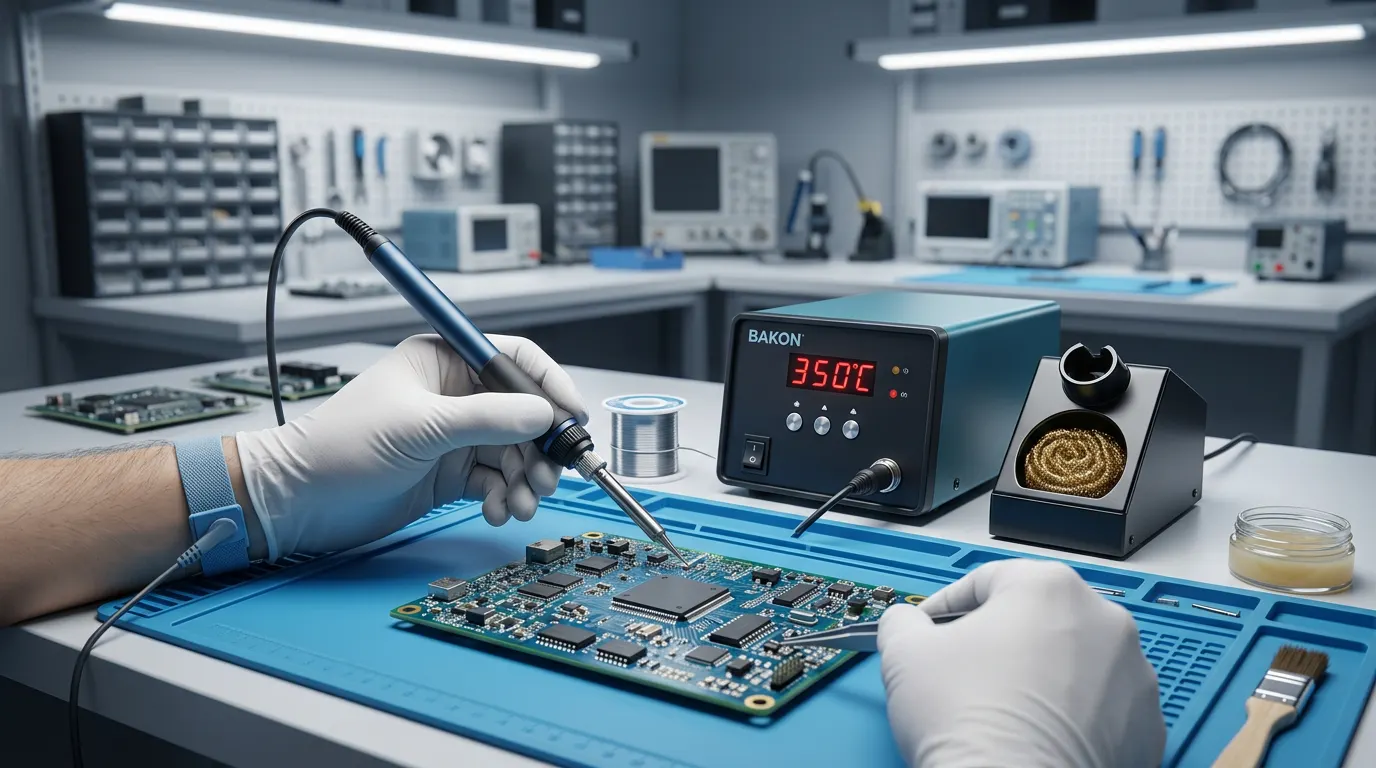
Buying a Soldering Station is trickier than it looks. Pick the wrong one and you're stuck with cold joints, fried components, and a bench full of regret. Pick the right one? Repair work just... flows. This guide skips the fluff and gets straight to what matters — heat control, build quality, safety — so you can find the Best Soldering Station for your actual setup. Not the shiniest one. Not the most expensive one. The one that fits how you work. Repair bench, assembly line, training lab, doesn't matter — the right soldering station makes a real difference, and it's worth getting this decision right the first time.
What is a Soldering Station?
Simple version: a Soldering station is a controlled heating setup for joining electronic parts. That's it at the core. But here's what makes it different from a random iron you'd plug into a wall socket — a proper Soldering Iron Station has a base unit, a temperature dial, and a handpiece, all talking to each other. Constantly. The base handles the power, the handpiece delivers heat, and together they hold temperature steady even on a long shift. That steadiness is really the whole point. Cheap irons swing hot and cold, and that swing burns components. A decent station doesn't do that. It just holds its line, joint after joint.
Why is it Important?
Soldering isn't just melting metal onto a board. It's repeating the same result, joint after joint, without thinking twice. A good soldering station cuts down rework, keeps heat-sensitive parts safe, and stops production lines from grinding to a halt every few minutes. Skimp on Soldering Equipment and you'll pay for it — failed joints, ruined boards, wasted material, wasted time. Anyone running PCB assembly, mobile repair, or industrial maintenance knows this already: unpredictable heat is expensive. A quality station isn't some nice-to-have upgrade. It's what separates consistent output from guesswork. And honestly, the gap shows up fast — in scrap rates, in rework hours, in how frustrated your operators get by lunchtime.
Types and Variants
Not every Soldering Station is built the same — and picking one blind almost always backfires. Here's the rundown:
- Analog stations — dial-based, cheap, fine if you're only soldering once in a while.
- Digital Soldering Station models — digital readouts, saved presets, built for repeatable industrial runs.
- Hot air rework stations — solder plus hot airflow, mainly for pulling and reworking SMD parts.
- ESD-safe stations — designed to keep static discharge away from sensitive components.
- Quick soldering station setups — small, fast to heat up, good for busy benches switching tasks constantly.
- Bakon soldering station models — a common pick across Indian electronics units, mostly for stable heating and sturdy handpieces.
Which one you need really depends on pace. Occasional repair work needs something different than a round-the-clock production floor.
Features to Look For
Before spending on any Soldering Tools, check these boxes first:
- Temperature accuracy — should hold steady, not drift by 20 degrees mid-job.
- Fast heat recovery — critical if you're soldering back-to-back, all day.
- ESD-safe build — skip this and you risk frying sensitive parts.
- Comfortable handpiece grip — your wrist will thank you after eight hours.
- Digital display — way easier to calibrate than an old analog dial.
- Interchangeable tips — different jobs need different tip shapes, plain and simple.
- Solid housing — meant for daily industrial abuse, not weekend hobby projects.
Cut corners on any one of these, and you'll find out the hard way — usually right in the middle of a rush order, when there's no time left to fix it.
Trivia — soldering itself isn't new. People were joining metal this way thousands of years back, mostly for jewelry, long before circuit boards existed.
Product Overview
Reliable Spares & Consumables counts among the established Soldering Station Manufacturers working with Indian electronics units, repair shops, and training centers. Their range covers several Bakon Soldering Station models, each built for stable heat, quick recovery, and long life under daily industrial use. Nothing fancy for the sake of fancy - just in-house production, real quality checks, and calibration before every unit ships out. The company runs a PAN India logistics setup too, so bulk and OEM orders do not sit around waiting. It's equipment made for the job, not a generic gadget grabbed off a random shelf.
Benefits
- Solder joints turn out consistent, unit after unit
- Way less chance of frying a component from overheating
- Throughput goes up once heat output stops fluctuating
- Operators aren't as wiped out after a full shift
- Rework drops, so does material wastage — costs follow
- Equipment simply lasts longer when calibrated properly
None of this is marketing fluff. It's just why serious benches drop basic irons for real Soldering Equipment sooner or later.
Applications and Use Cases
Here are some applications and use cases are mentioned below:
- PCB manufacturing and general electronics assembly lines
- Mobile repair centers, device servicing counters
- Training institutes teaching hands-on electronics skills
- Rework and maintenance departments on the factory floor
- R&D labs building and testing early-stage prototypes
Small repair counter or a full production floor — doesn't matter. The requirement stays the same: steady heat, no drama.
Did you know? A well-built station recovers its working temperature in seconds, even under repeated, rapid contact.
Comparison Table
Here is the comparison table that you should know about.
| Station Type | Best Suited For | Temperature Control | Maintenance Needs |
|---|---|---|---|
| Analog Soldering Station | Light, occasional use | Manual dial adjustment | Low |
| Digital Soldering Station | Industrial, repeatable tasks | Precise digital readout | Moderate |
| Hot Air Rework Station | SMD rework and removal | Adjustable airflow and heat | Moderate to high |
| ESD-Safe Soldering Station | Sensitive component handling | Stable, controlled output | Moderate |
Expert Tips and Buying Guide
A few things worth checking before you finalize anything — applies whether you're buying one unit or stocking a whole floor:
- Match it to your actual workload. Don't overbuy for occasional use, don't underbuy for a busy floor.
- ESD-safe certification matters if sensitive components are part of your daily work.
- Heat recovery speed beats flashy extras you'll probably never touch.
- Talk to your Soldering Station Supplier about spare tips and after-sales support before you buy, not after.
- Warranty terms differ a lot across Soldering Station Dealers — worth the five minutes to compare.
- Pick manufacturers who actually document their calibration and quality process.
A decent soldering station supplier does more than hand you a box. They help you land on the right fit.
Fact — ESD damage doesn't always show. A single static discharge can quietly kill a component with zero visible sign.
Reliable Spares and Consumables
Reliable Spares & Consumables, lead by Mr.JK Khowal, possesses 19 years of experience in the industry, including manufacturing and supplying ESD products and industrial electronics tools in India. With their own manufacturing facility and expertise, they are one of the leading providers of customized ESD solutions, soldering stations, BGA rework stations,ESD chairs, testers and ESD static control consumables that meet customer needs in the electronics manufacturing sector.Reliable Spares & Consumables manufactures the products using tested components and guarantees the best performance and lifespan with stringent in-house testing facilities and conformity to industry standards. With comprehensive OEM and bulk supplying options available, as well as a well established and efficient distribution channel nationwide. They are able to supply their goods promptly across India and improve workplace safety and productivity in offices.
FAQs
Q1. What's the real difference between a soldering iron and a soldering station?
Ans: A basic iron just heats up and stays hot — no control, no feedback. A soldering station adds a base unit that regulates temperature constantly, so the tip doesn't overheat or cool mid-joint. That control matters more than people think. It's why professionals switch after ruining a few boards with a plain iron.
Q2. How do I know if I need a Digital Soldering Station instead of an analog one?
Ans: If you're soldering occasionally, analog works fine — turn the dial, wait, go. But once work gets repetitive or precision actually matters, a Digital Soldering Station earns its keep. Saved presets, exact readouts, faster recalibration between jobs. Basically, if consistency affects your output daily, skip analog and go digital from the start.
Q3. Are Bakon soldering station models good for daily industrial use?
Ans: Yes, generally. Bakon soldering station units are common on Indian benches because they hold temperature steady and don't fuss during long shifts. They're not the flashiest option out there, but reliability counts more than looks on a busy floor. For repair labs and assembly lines running daily, they hold up well.
Q4. What should I ask a soldering station supplier before placing a bulk order?
Ans: Start with warranty terms and spare tip availability — those get ignored until something breaks. Ask about calibration documentation too; not every soldering station supplier bothers with it. Delivery timelines matter for bulk orders, so confirm that upfront. A good supplier answers these without hesitation. Hesitation usually means trouble later.
Q5. Can a quick soldering station handle heavy industrial workloads?
Ans: Depends on the model, honestly. A quick soldering station is built mainly for fast heat-up and switching between small tasks — great for repair counters, less ideal for nonstop high-volume production. If your floor runs constant, heavy soldering all day, you'll probably want something rated for sustained industrial use instead.
Q6. What's the biggest mistake people make when choosing Soldering Equipment?
Ans: Buying based on price alone. Cheap Soldering Equipment often can't hold steady temperature, and that inconsistency quietly ruins components over time. The smarter approach is matching equipment to actual workload — occasional use versus daily production — rather than just picking whatever's cheapest at the counter. That decision pays off later.
Conclusion
Picking a Soldering Station shouldn't come down to whatever's cheapest that week. It comes down to what your work actually needs — component sensitivity, daily workload, safety. Whether that's one repair bench or an entire production line, sourcing from established Soldering Station Manufacturers usually means fewer headaches later — tested gear, real support when something goes wrong. Get this part right, and honestly, everything downstream gets simpler.
| Ready to upgrade your bench? Contact to Reliable Spares and Consumables today and get equipment that actually holds up. |