

Ever had a board clear every test and still come back from the field dead? ESD is a common reason. A spark below 3,000 volts is invisible and painless to a person, yet plenty of chips are damaged well under that. So the failure hides. It shows up months later, usually at the customer’s end, and then everyone starts pointing fingers.
The fix is dull but it works: measure your controls. Resistance Meters tell you whether a mat or bench top really lets charge drain away. Add some ESD Testing Equipment to the mix and you have numbers to show in audits. In this blog, we will go through what to look for before you spend money on one.
What Are Resistance Meters and How Do They Work?
A resistance meter is basically a voltage source with a current gauge bolted on. It puts a small, known voltage across your sample, watches what flows, and shows the answer in ohms. That’s the whole trick. The skill is in how you set the test up.
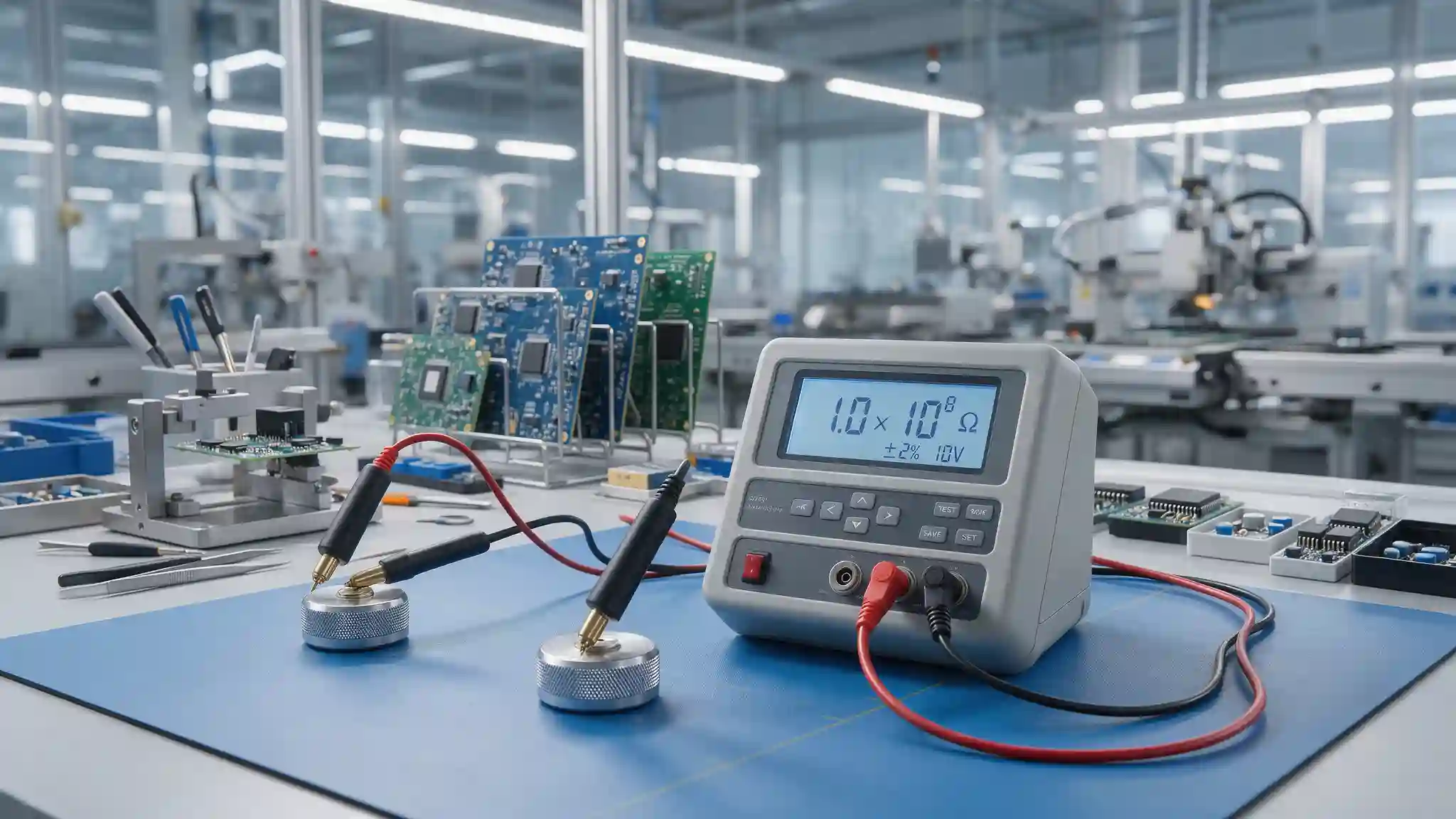
On most electronics floors, that means an ESD Resistance Meter and two weighted probes. Drop them on the surface, press test, jot down the number. High reading? Charge sits where it landed. Very low? It can dump all at once, and a fragile chip suffers for that as well.
One handheld ends up all over the plant, from the receiving dock to the line to the monthly audit. Here’s where it usually gets used:
- ESD mats on benches and floors.
- Wrist strap cords and ground points.
- Garments, trays and storage bins.
- New anti-static materials before approval.
Why Are Resistance Meters Important for ESD Testing?
Nobody sees a mat go bad. Carbon fills dry out. Coatings rub off where wrists rest. Floor polish stacks up in layers and starts acting like insulation. Last year’s mat looks the same and measures nothing like it, so ESD Testing can’t be a one-time job at installation.
Doing Surface Resistance Testing costs a few minutes per station. What it saves is bigger: fewer rejects, fewer angry emails from customers. Here’s what is riding on it:
- PCB parts such as ICs, MOSFETs and sensors, which fail at very low voltages.
- Anti-static surfaces, which wear down from cleaning and daily use.
- Workstations, which must stay compliant between audits.
- Your reliability figures, since latent defects slip past final inspection.
Types of Resistance Meters Used in Electronics Manufacturing
Different tasks call for different instruments, and the two Resistance Meters below are the ones you’ll meet most often in electronics plants.
Digital Surface Resistivity Meter
A digital surface resistivity meter reports resistivity in ohms per square, a figure that stays the same whatever the electrode size. That’s why labs and incoming inspection teams lean on it when they compare materials or approve a new supplier. Most units use concentric ring probes at a fixed test voltage, so repeated readings on the same sample land close together.
Surface Resistance Meter
A Surface Resistance Meter measures point-to-point resistance between two electrodes. It’s the quicker option. Walk a line with one, touch down on each mat and bench, and scribble the readings on the audit sheet. A full line takes a few minutes, not an afternoon.
Key Factors to Consider When Choosing Resistance Meters
Most buyers ask about price first. Flip that. Write down what the meter has to measure, then hold each of the resistance meters you’re considering up against that list. Four things matter most.
Measurement Range and Accuracy
Think about the oddest material on your floor, maybe a conductive tote or an old rubber mat. Your ESD resistance meter should read that one too, not only the easy ones. The usual ESD window is roughly 10⁴ to 10¹¹ ohms, and you want some room past both ends. Then read the accuracy claim. Two tests on one mat that disagree make for an uncomfortable audit.
ESD Testing Standards and Calibration
Which standard was the ESD testing equipment built to? Ask that first. Requirements sit in IEC 61340-5-1, and IEC 61340-2-3 describes how the test is done. It matters because electrode weight, electrode size and test voltage (10 V or 100 V, depending on range) all move the reading. Use the wrong probe and your numbers won’t hold up. Ask for a traceable calibration certificate too, and put a yearly recalibration in the diary.
Digital Display and Ease of Use
Dim shop floors punish bad screens. We’ve all squinted at a number that might be a 6 or an 8. A digital surface resistivity meter with a bright display avoids that, and a hold button and a full-shift battery help too. Weight is easy to overlook. A heavy or fiddly meter gets left in the drawer, and a test nobody runs has no control at all.
Product Quality and Technical Support
Handle the probes, cables and case if you can. Cheap build shows quickly. Support is the other half, because a meter with nobody to call turns into a paperweight after its first fault. Good Resistance Meters Manufacturers typically give you:
- A plain-English manual and test procedure.
- A warranty with clear terms.
- Calibration and repair service.
- Quick answers to technical questions.
Industrial Applications of Resistance Meters
Wherever sensitive electronics are handled, someone has to check that the controls still work. Resistance meters get used in places like these:
- PCB assembly lines, where mats and benches touch bare boards all day.
- Manufacturing floors, including flooring and footwear checks at entry points.
- ESD workstation testing at inspection and repair benches.
- Laboratories evaluating new anti-static materials against a specification.
- Packing tables, where bags and foam inserts meet finished boards.
A repair bench with open boards probably needs checking more often than a packing table. One schedule for the whole plant rarely suits both.
How to Choose Reliable Resistance Meters Manufacturers in India?
Price lists only get you so far with Resistance Meters Manufacturers in India. Ask for datasheets, compliance details and sample test reports, then see who actually sends them. Good suppliers back the product with paperwork and service. Reliable Spares & Consumables, a manufacturer of ESD products, builds its offering around these points:
- Clear compliance with IEC 61340 test methods.
- Calibration certificates and recalibration support.
- Ready stock and realistic delivery times.
- Responsive after-sales service across India.
- References from electronics and EMS clients.
Hold any shortlist of surface resistivity meter manufacturers to the same yardstick. If you’d like a second opinion on specifications, share your testing requirements with Reliable Spares & Consumables and get a clear technical answer before placing an order.
Choose the Right Resistance Meter for ESD Protection
Last quarter’s test says little about the mat on your bench today. That’s why the right resistance meters matter: a sensible range, a design that follows the standards, a body that’s easy to hold, and a supplier who answers the phone. A surface resistivity meter or a point-to-point model? That comes down to your team’s routine.
| Browse ESD products and testing tools at Reliable Spares & Consumables, or send them your mat and floor specs and ask which model they’d pick. |
FAQs
1. What are Resistance Meters used for in electronics manufacturing?
They check how well a material conducts or drains charge. Plants use resistance meters on mats, floors, garments and packaging, and to confirm materials meet ESD limits before use.
2. How does a Surface Resistivity Meter work?
A surface resistivity meter sends a voltage through electrodes resting on the material, measures the current, and shows resistivity in ohms per square. This lets you compare ESD materials on equal terms.
3. What factors should buyers consider when choosing Resistance Meters?
Range, accuracy, calibration and ease of use. A good esd resistance meter covers about 10⁴ to 10¹¹ ohms, follows IEC 61340 methods and has a display you can read at a glance. Calibration support counts just as much.
4. Why is resistance testing important for ESD protection?
Surfaces wear out over time. ESD testing equipment shows when a mat or bench has stopped draining charge, and regular surface resistance testing keeps discharge risk low.
5. How do I choose reliable Resistance Meters Manufacturers in India?
Look at build quality, datasheets, calibration and after-sales service. Reliable resistance meters manufacturers and surface resistivity meter manufacturers share clear documentation and still pick up the phone after delivery.